Websites for contractors
A website for your contracting business, built for you
FreeWebGuy designs and builds contractor websites: $0 to build, then $15 a month for hosting after you approve the site. The first version arrives within 48 hours of your brief, built around your finished projects, a clear process and a project request that asks about budget and timing before you drive out.
Pay nothing until you approve it.
About 3 minutes. No credit card.
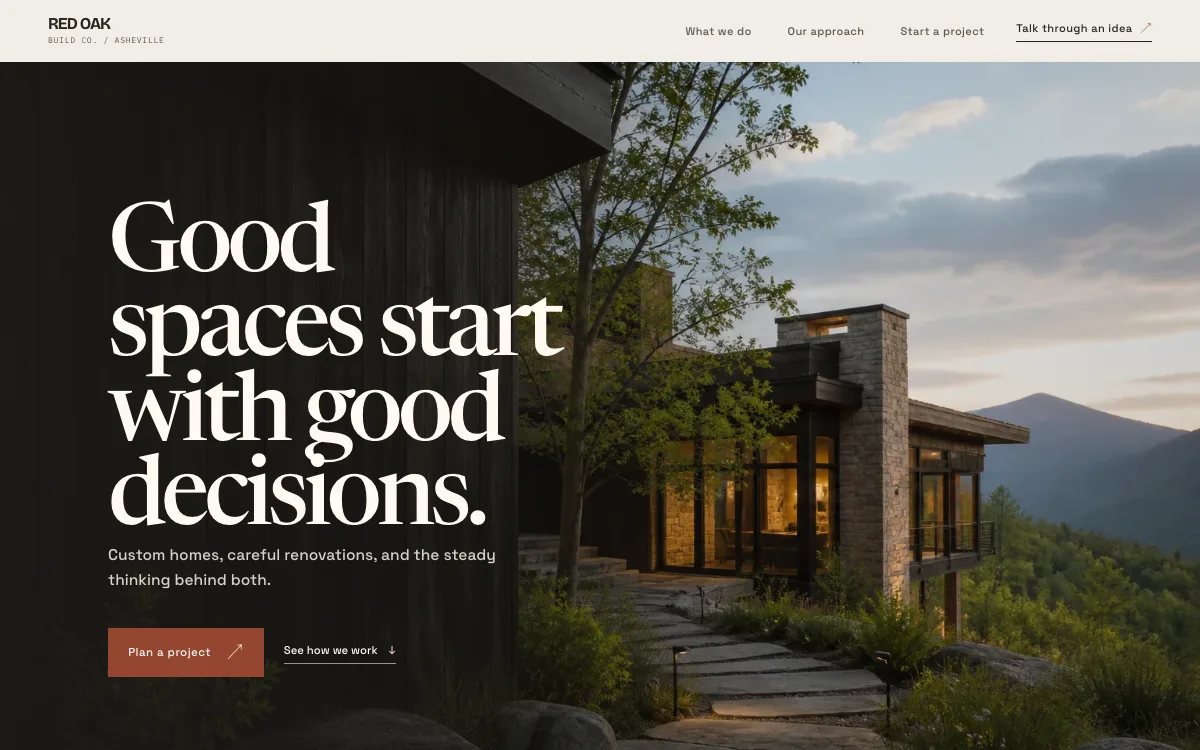
What a contractor website has to do
-
Let finished projects do the selling
People hire a builder or remodeler by looking at what they have already built. The site leads with finished projects: a few strong photos each, the scope of the job, and a line on what made it hard.
-
Set expectations on process and timing
Renovations and new builds run for months. A process page that walks through the first meeting, design, permits, the build and the final walk-through answers the questions that would otherwise eat your first phone call.
-
Qualify the inquiry
Not every inquiry is a fit. A project request that asks for the type of work, the location, the timing and a budget range lets you spend your evenings on the jobs you want.
The pages we build for a contracting business
Your brief decides the final list. These are the pages most contractors need, and the job each one does.
| Page | Why it is there |
|---|---|
| Home | Your best finished project up top, the kinds of work you take on and a start-a-project button. |
| A page for each type of project | Custom homes, renovations and additions, kitchens and baths, outdoor work: one page for each type you want more of. |
| Projects | One page per finished project once you have three or more worth showing, with photos, scope and a short story. |
| Process | What happens from first meeting to final walk-through, and roughly how long each stage takes. |
| About and licensing | Who runs the company, your license and insurance if you hold them, and the trades you bring in. |
| Service area | Where you build, and whether you travel for larger projects. |
| Start a project | A form that asks for project type, location, timing and budget range. |
See a contractor website we designed
-
Capabilities by scope
Custom homes, renovations and additions, interior finish work and pre-construction guidance each get a short description, so a visitor can tell straight away whether their project fits.
-
A project story with the facts first
The finished-project section opens with the brief, the setting and the materials before the photos. A visitor learns what the job was before they see how it turned out.
-
A door for early questions
The form asks what you are planning: a custom home, a renovation or addition, or an early-stage question. That last option suits clients who are a year away from breaking ground.
Open the full contractor website design example to click through it as a phone or desktop visitor would, or browse more home service website examples.
More designs for this kind of work
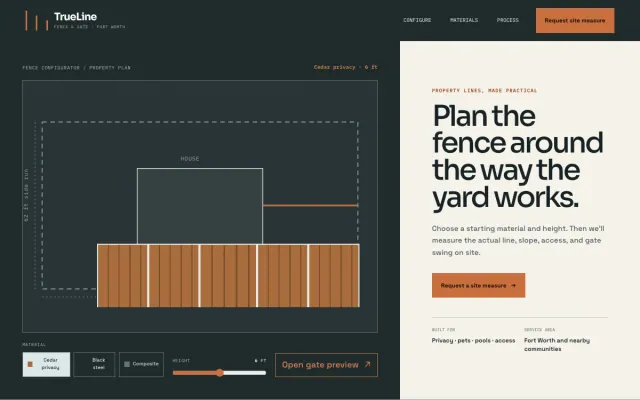
Fence Contractor Fort Worth, TX
TrueLine Fence & Gate - Fence Contractor website design example
A fence configurator, clear material comparison, and site-measure request
- Fence configurator
- Material comparison
- Site measure request

Pool Builder Scottsdale, AZ
Blue Depth Poolworks - Pool Builder website design example
Custom pools and outdoor rooms with a clear point of view.
- Pool design paths
- Design study
- Project inquiry
What to have ready for your brief
The brief takes about 3 minutes. Send what you have now; photos, documents and anything else on this list can follow by email.
- Your license number and the state that issued it, plus insurance details. California, for one, requires a contractor's license number in all advertising (Bus. & Prof. Code 7030.5).
- The project types you want more of, and the size range you take on
- Three to five finished projects, each with photos and a paragraph on the scope
- Your process, step by step, even as rough notes
- Your typical lead time before a new project can start
- The area you build in
- Trade or builder association memberships you hold, if any
What customers check before they call
- A license they can look up with the state board, if your state licenses contractors, and insurance stated plainly
- Photos of finished work, taken on real job sites
- A process that explains who manages the job and how often the client hears from you
- Where your office or shop is and the towns you build in
- Reviews or references from past clients on projects like theirs
What a contractor website costs
A contractor website from FreeWebGuy is $0 to build and $15 a month for hosting once you approve it: $180 for the first year, plus a domain if you need one.
| Route | What it costs | First year | Who builds it |
|---|---|---|---|
| DIY website builder | $17 to $49 a month, billed yearly | $204 to $588 | You build it |
| Freelance web designer | $2,000 to $7,600 to build, plus hosting | $2,060 to $7,900 | They build it |
| Web design agency | $5,000 to $15,000 to build, plus hosting | $5,060 to $15,300 | They build it |
| FreeWebGuy | $0 to build, $15 a month | $180, plus a domain if you need one | We build it |
Sources: Wix plans; Squarespace pricing; WebsiteSetup: small business website costs (updated November 22, 2025); Ueni: average cost for a website (updated September 22, 2026); Clutch: web designer pricing (updated September 21, 2026)
A page for each finished project is part of the standard build at launch. After launch you can add new projects yourself with the site's AI builder, or ask us to quote larger additions before any work starts.
The pricing page lists what the $15 plan includes and what costs extra. To price your own situation, use the website cost calculator or compare FreeWebGuy with Wix, Squarespace and web designers.
Prefer to build it yourself?
Building your own contractor website works if you have the evenings for it. These five steps cover what the site needs on any website builder.
-
Choose a builder with large photo galleries that still load quickly on a phone.
-
Pick your three best finished projects and write a short story for each: the client's goal, the scope and the result.
-
Write a process page that runs from first meeting to final walk-through.
-
Add your license number to every page if you hold one, and read your state board's advertising rules.
-
Add a project form that asks about type, location, timing and budget range.
For a page-by-page checklist, read What should be on a small business website? A page-by-page checklist.
How FreeWebGuy builds it
-
Send the brief
About 3 minutes
Tell us what you do and what you want visitors to do.
You pay $0
-
We build it
Within 48 hours of your brief
We use AI to build fast. A person checks every first version before you see it.
You pay $0
-
You review the preview
At your pace
Open the private link and tell us what to change.
You pay $0
-
Approve and go live
When you decide
When you approve the preview, you set up your SMBcrm account and card for the $15 hosting plan.
You pay $15 a month starts here
If you are not ready to launch, you owe nothing.
Questions contractors ask
Something else on your mind? Email hello@freewebguy.com. We reply within one business day.
How much does a contractor website cost?
A contractor website from FreeWebGuy is $0 to build and $15 a month for hosting after you approve it: $180 in the first year, plus a domain if you need one. Project pages and a process page are part of the build, with no setup fee.
What makes a good contractor website?
Finished projects, shown well. A good contractor site leads with real photos of completed work, explains the process and timeline, shows your license and insurance, names the area you build in, and ends with a project request that asks enough to tell a good lead from a poor fit.
What should a contractor website design include?
At minimum: a home page, a page for each type of project, a projects gallery, a process page, an about page with licensing and insurance, a service area and a start-a-project form. Add a page for each finished project once you have three or more worth showing.
Should a contractor build a website?
Yes, if referrals alone don't fill your calendar. Clients planning a renovation look at a contractor's past work before they call, and a website is the one place where you decide how that work is shown. It also gives your Google Business Profile somewhere to send people.
How many projects should a contractor show on a website?
Three to five strong ones beat twenty weak ones. Pick projects that match the work you want more of, show a handful of photos of each, and add a short story: what the client wanted, what you built and what was difficult about it.
Should a contractor list price ranges on the website?
A starting range helps if you can give one without guessing, because it screens out projects far below your minimum. If every job is different, explain what drives cost (size, materials, site conditions) and ask for a budget range on the request form instead.
Is a contractor website the same as a lead marketplace?
No. A marketplace can sell the same lead to several contractors. Your own website sends inquiries only to you, under your name, and its request form asks the questions you care about. FreeWebGuy builds the site, and the inquiries it collects come to you.
Related industries and guides
- Website for roofers An inspection request, a step-by-step process and photos of roofs you have finished.
- Website for handymen A job list, clear minimums and a punch-list request that bundles small fixes.
- Website for electricians Separate paths for repairs, panel and capacity upgrades, and lighting projects.
- How much does a small business website cost in 2026?
- What should be on a small business website? A page-by-page checklist
- How to write website copy for a local business
- $0 to build
- First version within 48 hours of your brief
- $15 a month for hosting, only after you approve the preview and go live
- Month to month, no contract
When you approve the preview, you set up your SMBcrm account and card for the $15 hosting plan. That is the only time we ask for payment details.