Websites for food trucks
A website for your food truck, built for you
FreeWebGuy builds websites for food trucks: $0 to build and $15 a month for hosting once you approve the site. Your first version arrives within 48 hours of your brief, built around a weekly stop board that marks today, a priced text menu and a catering request that asks about parking and power. Pay nothing until you approve it.
Pay nothing until you approve it.
About 3 minutes. No credit card.
What a food truck website has to do
-
Say where the truck is, today and all week
People find a truck with no storefront by its schedule. Someone who opens your site at 11:40 wants today's stop, the cross streets and the hours, then whether Friday is near their office. A board that holds the whole week with today marked answers both without a scroll through old posts.
-
Keep the menu readable, with a price on every line
A phone photo of the menu board blurs on a small screen, goes stale the first time a price moves and cannot be searched. Items as page text with a price beside each, plus a line on the dish you want first-timers to try, so they walk up knowing what to order.
-
Turn "do you do events?" into a complete request
An office lunch or a wedding is a bigger order than any single stop, and it usually starts as a two-line message. A form that collects the date, the headcount, the serving window and the site's parking and power gives you a lead you can quote from at once.
The pages we build for a food truck
Your brief decides the final list. These are the pages most food trucks need, and the job each one does.
| Page | Why it is there |
|---|---|
| Home | This week's stops with today marked, the truck's phone number, a short priced list and the catering button in the first two screens. |
| This week | Every public stop by day: the place, the cross streets, the hours, and what happens on prep or booked days. |
| Menu | Each item as text with its price, what is in it, and the dietary notes a small kitchen can honestly give. |
| Changes and alerts | Where a moved or sold-out stop gets posted first, and a text or email sign-up for the regulars. |
| Catering and events | Truck service and drop-off, minimums if you publish them, what the truck needs on site and the request form. |
| Payment and permits | Cash or card, whether prices include tax, and your permits stated as they are posted on the truck. |
| About and contact | Who cooks, how the truck started, photos of the truck and the food, and the phone line. |
See a food truck website we designed
-
A stop board that knows what day it is
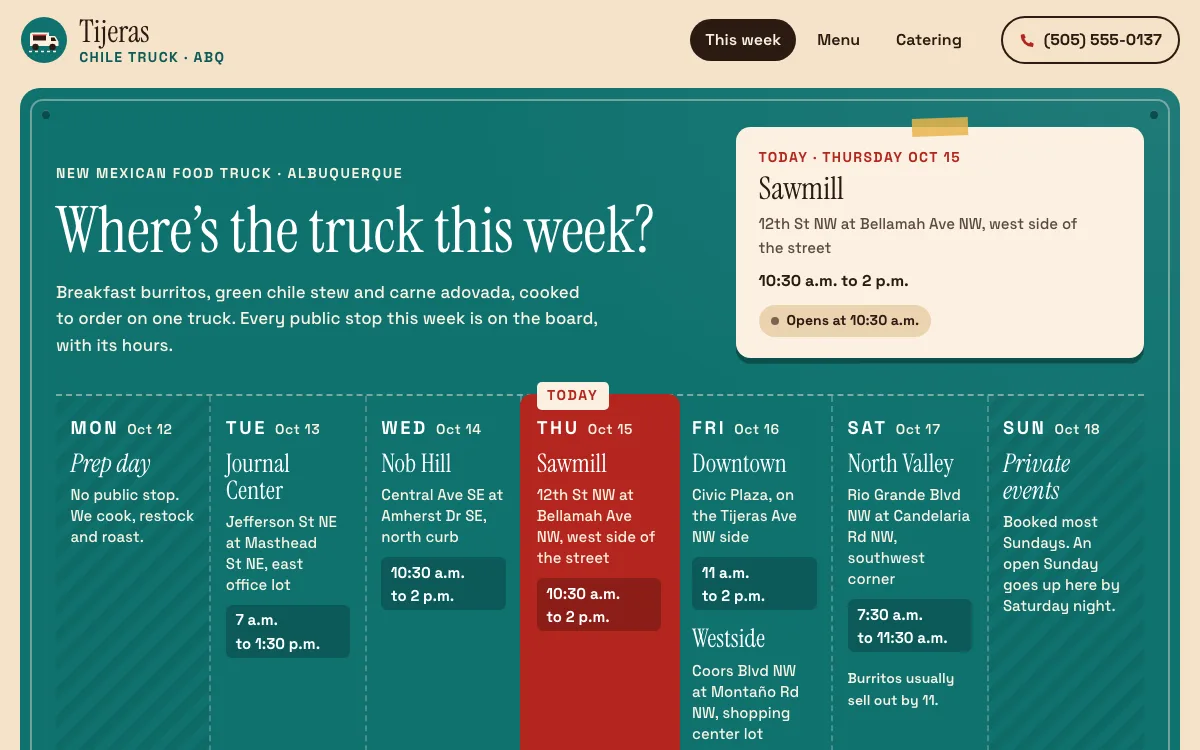
Seven columns, one per day, with the place, the cross streets and the hours. The clock in the truck's time zone picks today's column, colors it and repeats that stop in a card at the top with an opening or closing note, so "where are you right now" is answered first.
-
A text menu with the chile question settled first
Every item is page text with its price on the row. Three short cards explain red, green and Christmas, with a heat bar on the two sauces, so a first-timer knows what to say at the window. A filter trims the list to vegetarian or pork-free dishes.
-
An event request that asks what the truck needs
The catering page lists what a site needs: parking room, overhead clearance, power and permission to be there. The form asks for the date, the headcount, the serving window and site notes, so you quote from a full request instead of a guess.
Open the full food truck website design example to click through it as a phone or desktop visitor would, or browse more restaurant and local shop website examples.
What to have ready for your brief
The brief takes about 3 minutes. Send what you have now; photos, documents and anything else on this list can follow by email.
- A typical week of stops: where you park, which corner and the hours, plus the days you prep or take bookings
- Your menu as a list with a price for each item, and the dish you want first-timers to try
- How you answer heat, vegetarian and allergy questions at the window
- Where a moved or sold-out stop gets posted first, and whether you want a text alert sign-up
- Catering options: truck service, drop-off, minimums if you publish them, and how far you travel
- What the truck needs at a site: parking length, clearance, power, and the paperwork a venue can ask for
- Photos of the truck, the food and the line, shot in daylight
What customers check before they visit
- A schedule that is current, because a stale board suggests the truck may not be there either
- Prices on the menu, because a menu without them sends some visitors away before they find the truck
- Your health permit and fire inspection named as your city issues them, if you hold them, with no score or badge you cannot back up
- A plain line on allergies that says what a small kitchen can and cannot promise
What a food truck website costs
A food truck website from FreeWebGuy is $0 to build and $15 a month for hosting once you approve it: $180 for the first year, plus a domain if you need one.
| Route | What it costs | First year | Who builds it |
|---|---|---|---|
| DIY website builder | $17 to $49 a month, billed yearly | $204 to $588 | You build it |
| Freelance web designer | $2,000 to $7,600 to build, plus hosting | $2,060 to $7,900 | They build it |
| Web design agency | $5,000 to $15,000 to build, plus hosting | $5,060 to $15,300 | They build it |
| FreeWebGuy | $0 to build, $15 a month | $180, plus a domain if you need one | We build it |
Sources: Wix plans; Squarespace pricing; WebsiteSetup: small business website costs (updated November 22, 2025); Ueni: average cost for a website (updated September 22, 2026); Clutch: web designer pricing (updated September 21, 2026)
A weekly stop board, a text menu and an event request fit the standard build. Text alerts are billed by usage if you turn texting on, and online ordering carries the ordering service's own fees.
The pricing page lists what the $15 plan includes and what costs extra. To price your own situation, use the website cost calculator or compare FreeWebGuy with Wix, Squarespace and web designers.
Prefer to build it yourself?
Building your own food truck website works if you have the evenings for it. These five steps cover what the site needs on any website builder.
-
Pick a builder you can edit from your phone, because the schedule changes before the truck leaves the commissary.
-
Build the home page around this week's stops: one block per day naming the spot, the corner and the hours.
-
Type the menu as text with a price on every item, and add only the dietary notes you can stand behind.
-
Write a catering page with your options, what the truck needs on site, and a form that asks the date, headcount and start and end times.
-
Put the site link in your Google Business Profile and social bios, then check the schedule on a phone every Sunday.
For a page-by-page checklist, read What should be on a small business website? A page-by-page checklist.
How FreeWebGuy builds it
-
Send the brief
About 3 minutes
Tell us what you do and what you want visitors to do.
You pay $0
-
We build it
Within 48 hours of your brief
We use AI to build fast. A person checks every first version before you see it.
You pay $0
-
You review the preview
At your pace
Open the private link and tell us what to change.
You pay $0
-
Approve and go live
When you decide
When you approve the preview, you set up your SMBcrm account and card for the $15 hosting plan.
You pay $15 a month starts here
If you are not ready to launch, you owe nothing.
Questions food trucks ask
Something else on your mind? Email hello@freewebguy.com. We reply within one business day.
How much does a food truck website cost?
A food truck website from FreeWebGuy is $0 to build, with hosting at $15 a month once you approve it. Year one comes to $180 plus a domain if you need one, with no setup fee and no contract. The stop board, menu and catering request are part of the build.
Where should a food truck post its weekly schedule: Instagram or the website?
On the website first, with the social post pointing there. A feed buries Tuesday's stop under Thursday's photo, and the reach is not yours to keep. A schedule page with the whole week in text is what you want a search for your truck's name to open.
How does the website know which stop is today?
The board checks the clock in the truck's time zone, marks that day's column and repeats the stop in a card at the top with an opening or closing note. You enter the week once. The Tijeras Chile Truck example shows it working.
What happens to the schedule when the truck has to move or close early?
Decide where a change gets posted first, usually your schedule page, and say so there. The moved day gets a tag and the new spot before any social post goes out, and a text alert reaches the regulars who never look.
Do I have to publish my catering minimum and per-person price?
No, but publishing the minimum saves everyone a wasted email. Many trucks charge a minimum whatever the headcount, and a party of twenty should learn that on your page, not after planning around you. State the minimum and what it includes, and say the rest is quoted.
Can a food truck with no street address have a Google Business Profile?
Yes, as a service-area business with the home address hidden, so your stops are not pinned on the map. Put the website in the profile so the schedule page does the locating, and use the profile's posts for this week's stops.
What should a food truck website say about permits and the commissary?
Name the permit the way your city issues it, and describe the commissary as the permitted kitchen where you prep and store food. Rules vary by city and state, so claim only what you hold. Skip permit numbers, inspection scores and "approved" badges, and never list the commissary address as a place to eat.
Related industries and guides
- Website for restaurants A menu in real text, hours, location and your order and reservation links.
- Website for coffee shops Menu, hours and the feel of the room, readable on a phone.
- Website for bakeries What's in the case, custom-order requests and pickup details.
- Google Business Profile websites shut down: what to do now
- How much does a small business website cost in 2026?
- Do I need a website for my small business?
- $0 to build
- First version within 48 hours of your brief
- $15 a month for hosting, only after you approve the preview and go live
- Month to month, no contract
When you approve the preview, you set up your SMBcrm account and card for the $15 hosting plan. That is the only time we ask for payment details.